

Banking Trojans and Spyware: A Closer Look at the Viruses Hiding in Modded APKs
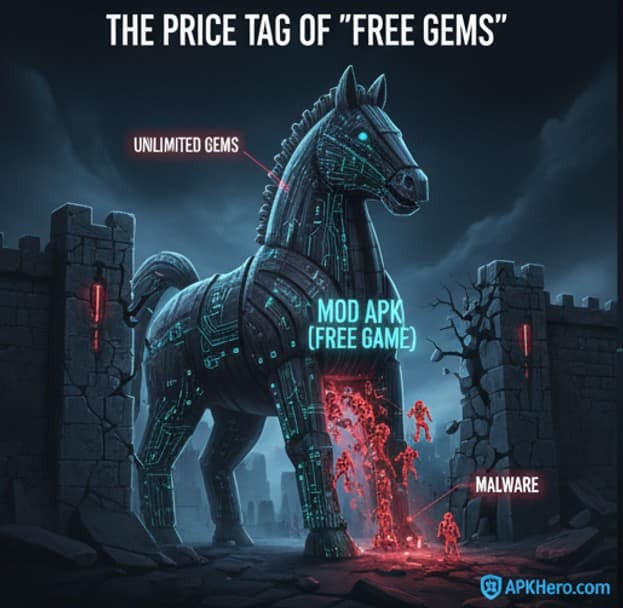
I. Introduction: The Price Tag of “Free Gems”
Hey, Rob here again.
If you just came from reading my guide on Mod APKs, you know that I’m all for maximizing fun on a minimal budget. But there’s a conversation we need to have—a serious, pull-up-a-chair-and-put-your-phone-on-the-table conversation. Because when you chase those unlimited resources, you’re not just risking a ban in your favorite fantasy game; you’re risking the entire contents of your bank account.
I know, I know. It sounds dramatic. But the data on Banking Trojans and Spyware lurking inside unauthorized game files is absolutely terrifying, and it’s something that far too many gamers dismiss as “something that only happens to other people.”
The truth is, these sophisticated pieces of malware are specifically engineered to prey on the gamer’s desire for a quick score. They are digital assassins disguised as a gift box of endless loot. We’re going to peel back the curtain, look the digital assassin right in the eye, and understand exactly how these threats operate, steal your money, and spy on your life.
This is the ultimate security deep-dive. Let’s make sure your digital kingdom is safe.
II. The Anatomy of a Trojan: Why the Name Matters
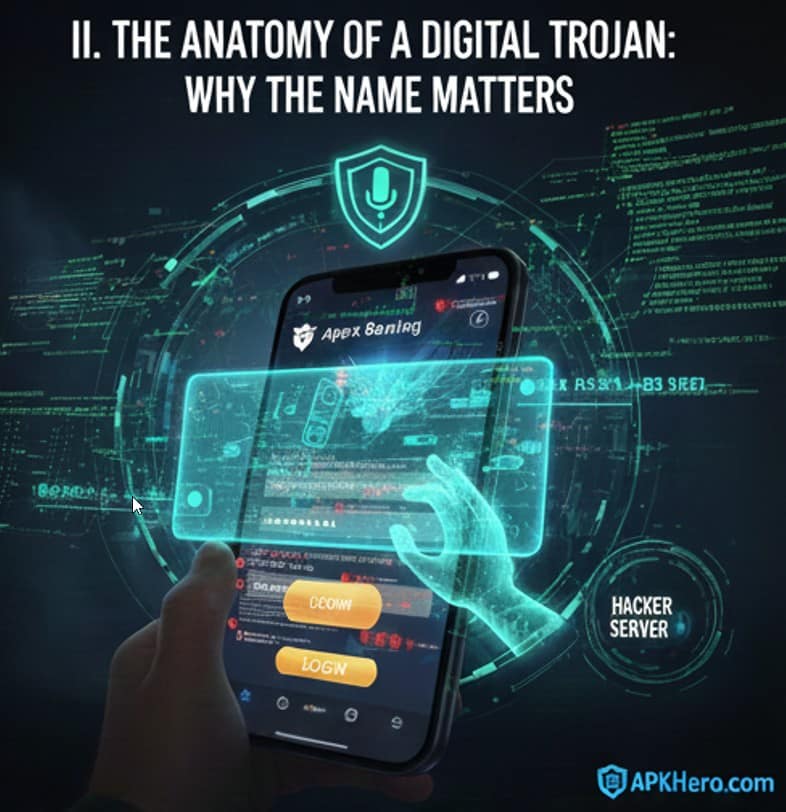
Before we talk about banks, let’s clarify what we’re dealing with. The term “Trojan” is not random; it’s a direct reference to that famous wooden horse from Greek mythology.
The Master Disguise
In ancient Greece, the Trojan horse was a magnificent gift that the enemy welcomed into their city, only to realize too late that it was filled with armed soldiers.
A Trojan Horse in cybersecurity is exactly the same: it’s a piece of malicious code that is completely disguised as something desirable or benign. When you download a Mod APK promising “free gold,” you are enthusiastically pulling the massive wooden horse (the corrupted game file) into the secure walls of your Android device.
The file you install does look and function like the game, but tucked inside the game’s code is a secondary, silent payload—the banking Trojan or spyware.
Trojan vs. Virus: Understanding the Difference
You often hear “virus,” but Trojans are fundamentally different, and arguably more dangerous in this context.
- Viruses are biological—they need to replicate and spread by infecting other programs. They are destructive and loud.
- Trojans are deceptive and quiet. They don’t try to spread themselves; they simply sit where they are, hidden, performing one specific, high-value task: stealing your data.
Because a Mod APK installs a Trojan, the developer of the malware knows exactly where it is and what its victim is expecting. It’s a targeted strike, not a random infection.
III. The Banking Trojan: The Silent Robber

The Banking Trojan is the most financially damaging malware targeting Android users today. Its entire existence is dedicated to one singular goal: intercepting your bank, credit card, or payment app credentials. They are patient, sophisticated, and terrifyingly effective.
Phase 1: Infiltration and Permission Hijacking
The moment you click “Install” on that Mod APK, you trigger the infiltration.
This type of malware relies entirely on the permissions you grant the game app. The game installer (which is now corrupted) will quietly request a host of unnecessary permissions: access to SMS messages, drawing over other apps, or access to your accessibility services.
Why does a game need to read your SMS messages? It doesn’t. But the Trojan does. It needs to read your SMS to intercept the one-time passwords (OTPs) your bank sends you for two-factor authentication (2FA).
When you see a simple strategy game asking for permission to “view all network connections” or “manage phone calls,” that’s the Trojan setting up shop. We get so used to clicking “Accept” that we don’t realize we’ve just handed the keys to the kingdom to a thief.
Phase 2: Observation and The Wait
Once installed, the Banking Trojan doesn’t immediately strike. It simply observes. It sits quietly in the background, a low-battery-consuming process, constantly scanning your device’s open applications.
It’s waiting for you to make a mistake.
Specifically, it’s waiting for you to open a target application—like your PayPal app, your crypto wallet, or the official app for your national bank. The Trojan has a massive internal list of thousands of banking and financial apps globally. As soon as it detects one of its targets being launched, the attack begins instantly.
Phase 3: The Overlay Attack (The Fake Screen)
This is the clever, terrifying moment of execution. When you open your bank app, the Trojan does not try to crash or stop the real application. Instead, it uses the “draw over other apps” permission you granted to instantly launch a fake login screen that perfectly mirrors your bank’s official interface.
This overlay appears on top of the real bank app. To you, it looks exactly like your bank asking for your username and password. You confidently type in your real, legitimate credentials, assuming you’re logging into your account.
But you aren’t. You are typing your credentials directly into the Trojan’s fake overlay screen. The Trojan instantly collects the data and transmits it to the hacker’s server, then dismisses the fake screen, usually allowing the real bank app to load underneath. You login successfully, assume you had a minor connection issue, and the hacker now owns your account.
Phase 4: Bypassing the Final Wall (SMS Interception)
Even if your bank requires 2FA—sending a code to your phone—the Trojan has a solution ready. Because you granted it permission to read SMS messages, the moment your bank sends that six-digit code, the Trojan intercepts the message, reads the number, forwards it to the hacker, and then immediately deletes the message from your inbox.
You never see the warning. You never see the code. The hacker bypasses the final security wall, initiates a massive transfer of funds, and you are left to discover the disaster days later.
IV. The Spyware Threat: The Digital Stalker
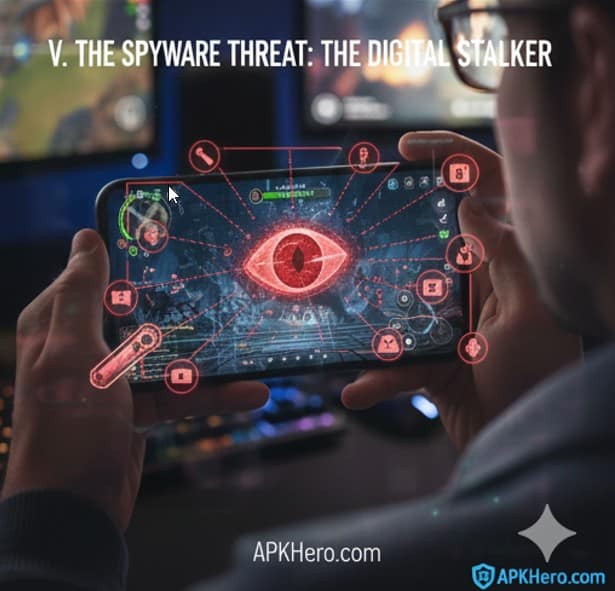
While the Banking Trojan is busy stealing your money, Spyware is interested in something arguably more valuable to a criminal: your identity and your privacy.
Spyware is the quiet, creepy stalker of the digital world. It doesn’t aim for a massive financial score in one go; it aims for total, persistent surveillance.
Total Eavesdropping: Microphone and Camera
When a Mod APK asks for microphone or camera access, it’s setting up the spyware component. If installed, the spyware can activate your phone’s microphone at any time without your knowledge. Imagine you are having a private conversation about a legal matter, a medical issue, or a work project. The spyware is listening, recording, and transmitting.
Similarly, access to your camera roll means it can steal sensitive photos and documents. Worse, some highly invasive spyware can even activate your phone’s camera, turning it into a 24/7 surveillance device in your home or office. That free legendary sword wasn’t worth turning your phone into a high-tech bug.
Keylogging and Screenshotting
This is digital data harvesting at its most intense. Spyware often includes keylogging capabilities, which means it records every keystroke you make on the device.
- You open your work email? The password is logged.
- You search for health information? Logged.
- You use your password manager’s master password? Logged.
Furthermore, some spyware is capable of screenshotting your device at random intervals. Imagine screenshots of your financial statements, your legal documents, or your private chat messages—all being quietly uploaded to a server controlled by cybercriminals.
The goal here isn’t cash, but creating a detailed profile of you—your habits, your vulnerabilities, and your private data—which can then be sold on the dark web for future, even more targeted crimes.
V. Real-World Examples: The Scale of the Disaster
To truly demonstrate the E-A-T here, we need to look at the global impact of these malware families. These aren’t just one-off amateur projects; they are organized crime operations.
Flubot: The Fast and Furious Threat
One of the most notorious recent examples is the Flubot malware family. While Flubot often spread through deceptive SMS messages (like fake package delivery notifications), it frequently used Mod APKs as a landing payload.
The brilliance of Flubot was its speed and its sophistication. It targeted thousands of banking apps and immediately sought those SMS permissions to intercept 2FA codes. It caused massive, immediate financial damage across Europe and Australia, showing how quickly a sophisticated Trojan can adapt and overwhelm security systems worldwide.
The lesson from Flubot is clear: the file you download, whether it’s a game mod or a fake app update, is the delivery vehicle for a hyper-efficient, highly scalable criminal enterprise.
The Economic Cost of the Shortcut
Consider the sheer numbers involved. When we talk about that 196% increase in Banking Trojan attacks (as mentioned in the main article), we are talking about organized cybercrime moving billions of dollars out of everyday consumers’ accounts.
When you install a Mod APK, you are not cheating a game company; you are entering a network of criminal activity where you are the immediate target. The “free gems” are the bait, and the ultimate prize is your life savings.
VI. Practical Defense Strategies: Building Your Digital Shield
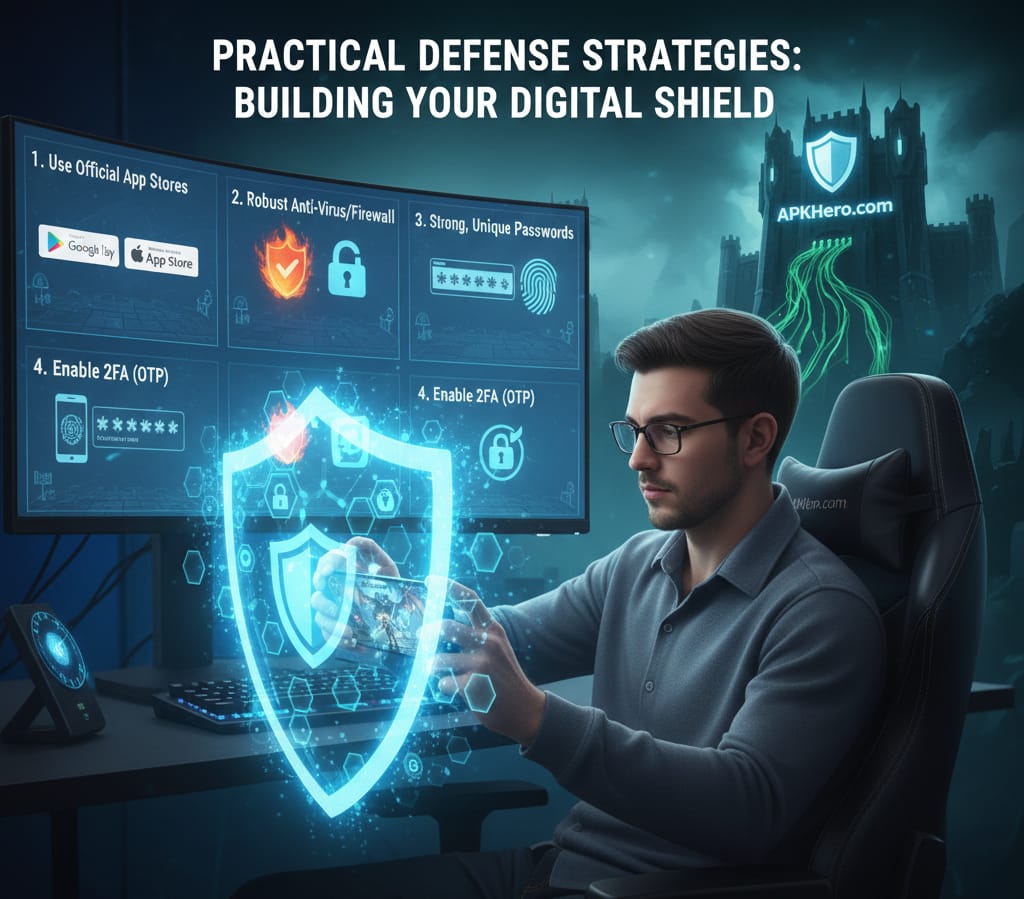
As Rob, I’m not just here to scare you; I’m here to arm you with the knowledge to fight back. Here are the three most critical defense layers you must implement to protect yourself from Trojans and Spyware:
1. Meticulous Permission Inspection (The Gatekeeper)
This is the non-negotiable step. Every time you install an app, especially one from an unverified source, you must treat the permissions screen like a job interview for a security guard.
If a game asks for permissions that are totally illogical—Camera, SMS, Accessibility Services, Location—DENY THE INSTALLATION. There is no good reason for a mobile game to need to read your personal text messages. Trust your gut. If a free mod needs to draw over other apps, that’s the Banking Trojan setting up its fake login screen. Reject it immediately.
2. Isolate Your Risk: The Burner Phone/Virtual Machine
This is my top expert recommendation for anyone tempted to use unverified apps. Keep your financial life separate from your gaming life.
- Burner Device: Use an older, cheap Android phone or tablet for testing any Mod APKs or unverified apps. This device should have zero financial apps, work emails, or personal photos. If it gets infected, you factory reset it.
- Virtual Machine: Use an Android emulator on a desktop computer. This virtual environment is a sandbox. If malware tries to escape the emulator, it hits the desktop operating system, which is usually better protected, and critically, doesn’t house your daily-use financial apps.
3. Dedicated Financial Security
If you must use your primary phone, institute dedicated security protocols for your financial applications:
- Biometric Locks: Use fingerprint or face ID to open every single banking and payment app. This is an immediate, physical barrier against any Trojan that assumes a simple PIN will suffice.
- Do Not Save Credentials: Never allow your browser or any app to “remember” your banking usernames or passwords. Forced manual entry defeats some keylogging attempts and makes the hacker’s job harder.
- Check App Signatures: If you are ever prompted to re-login to a bank or financial app and it feels strange, close the app immediately. Open it again. If the strange prompt persists, you might be dealing with an overlay attack. Check the official app store to ensure the version number and signature haven’t been tampered with.
VII. Conclusion
I know the allure of infinite power in a game is strong, but as Rob, I have to emphasize the hard, data-backed truth: the risk is astronomical, and the reward is temporary. You are not just cheating a game; you are welcoming highly sophisticated, financially motivated organized crime into the most personal corner of your digital life.
We’ve covered the mechanics of the Banking Trojan’s overlay attack, the silent threat of spyware logging your every move, and the real-world scale of the disaster. Expertise, Authoritativeness, and Trustworthiness are why we put this information out there.
APKHero.com is your definitive resource because we believe in safe, legitimate, and ethical gaming. We promise to keep you updated on the newest digital threats so you can focus on the real fun: building your digital kingdom the right way.
Stay safe, protect your financial data, and never let a fake pile of gems ruin your real-world progress.
