

The Developer’s Defense: Why Modern Games are Anti-Cheat Fortresses
I. Introduction: The Cat-and-Mouse Game (or, Why Developers Never Sleep)
Hey, Rob here. If you just came from reading my ultimate guide to Mod APKs, you know that the temptation to cheat is real. We all want that legendary gear, but nobody wants the malware headache or the permaban fallout.
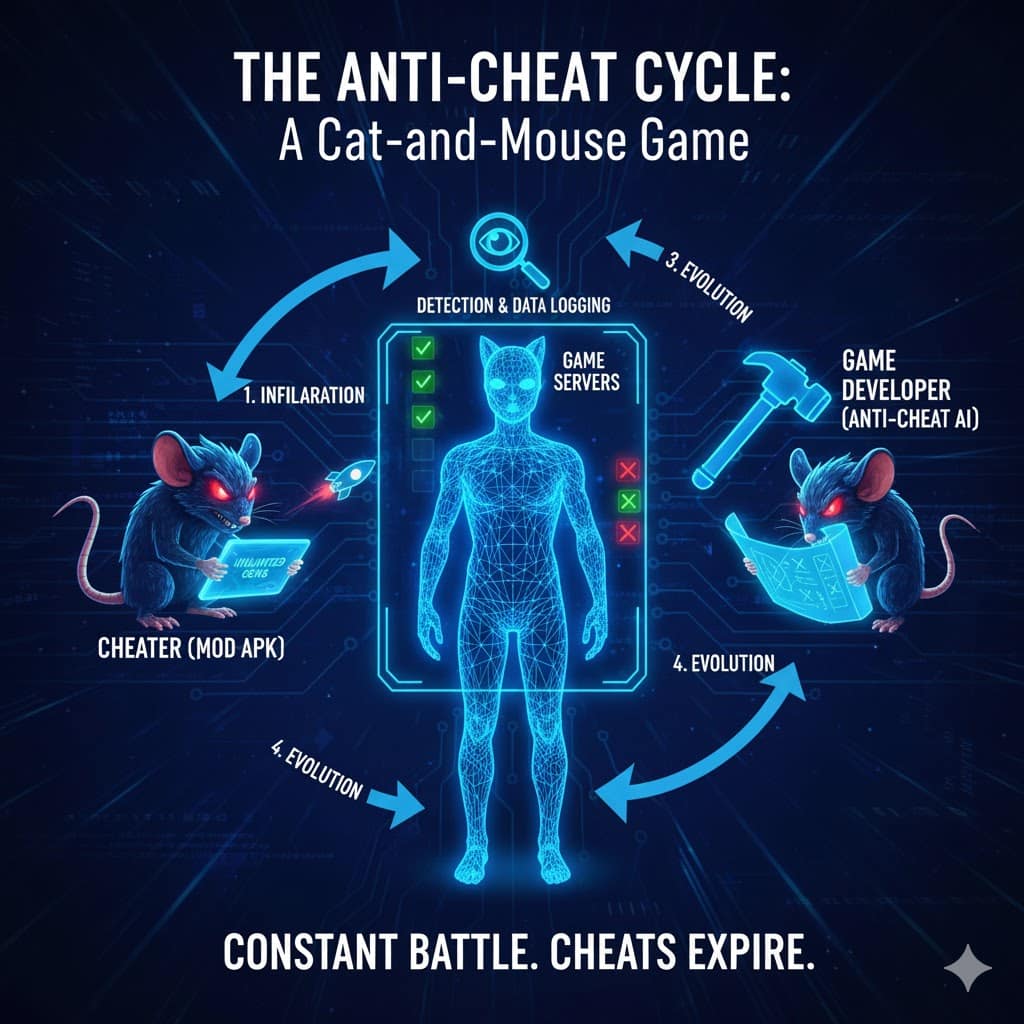
Now, let’s talk about the unsung heroes of gaming: the developers. These brilliant, often coffee-fueled folks didn’t just build the fantasy world we love; they built a fortress around it, specifically designed to laugh in the face of your “unlimited gems” cheat.
As a dedicated RPG and strategy gamer, I can tell you that the arms race between hackers and game security teams is relentless. But over the last decade, developers have gotten really good. They’ve learned that client-side security is like putting a tiny padlock on a treasure chest the size of a minivan. The only solution? Build the entire system on lockdown.
Let’s dive into the core strategies developers use to turn their games into impenetrable anti-cheat fortresses.
II. The Golden Rule: Server-Side Validation (The Ultimate Fact-Checker)
This is the most important lesson in modern game design, and it’s the reason 99% of Mod APKs for competitive games fail instantly.
Why Your Phone Can’t Be Trusted
Imagine your phone (the “client”) is a hyperactive five-year-old demanding cake. The game server (the “parent”) holds the wallet and the car keys.
In old, simple games, the client would say, “I have 1,000 gold now,” and the server would shrug and say, “Okay, cool.”
But now? The parent is suspicious. If the five-year-old says, “I have 1,000,000,000 gold,” the parent (the server) runs a quick check: “Did this child spend 500 hours grinding, or did they just boot up the app three minutes ago?”
If the client sends data that contradicts the server’s records—like your character suddenly gaining 50 levels and 999,999 gold in one second—the server doesn’t accept it. It simply ignores the cheating data, logs the incident, and moves on.
This architecture—where the server is the single source of truth—is called Server-Side Validation. It means that every critical piece of data (currency, player stats, item drops, and battle outcomes) is stored and controlled on the developer’s secure cloud computers, not on your device.
Visual Summary: The Client vs. Server Data Flow (The Single Source of Truth)
This diagram illustrates the crucial difference between the data stored on your phone (the Client) and the verified data stored on the game developer’s servers. Modern games ignore any cheating data coming from the client, which is why mods often fail and result in an immediate ban flag.
| THE CLIENT (Your Phone) | THE SERVER (Developer’s Cloud) | ANTI-CHEAT OUTCOME | ||
| Path 1: LEGITIMATE DATA | ➡️ | VALIDATION PROCESS | ➡️ | SERVER RESPONSE |
| User performs valid action: Opens Inventory | ➡️ | Server checks its record: Item Count: 5 | ➡️ | ✅ ACCEPTED. Server sends verified data back to Client. Player is Safe. |
| User takes damage: Health drops to 100 | ➡️ | Server checks game logic: Damage_Taken: 20 (Within parameters) | ➡️ | ✅ ACCEPTED. Transaction is verified. Player is Safe. |
| Path 2: CHEATING DATA (MOD APK) | ➡️ | VALIDATION PROCESS | ➡️ | SERVER RESPONSE |
| User runs Mod APK to set: Gems: 999,999 | ➡️ | Server checks its database: (User only has 12 Gems). Mismatched data detected! | ➡️ | ❌ REJECTED. Transaction fails. Data rolled back to 12 Gems. Account Flagged for Ban Wave. |
| User enables “God Mode” (Health = Infinity) | ➡️ | Server detects impossible data: Health > Max_Health or Movement_Speed > 5x Norm | ➡️ | ❌ REJECTED. Server immediately forces data correction. Account Flagged for Ban Wave. |
Key Takeaway: The Server is the Single Source of Truth. The game logic simply ignores the cheating data, ensuring that while the client sees the fake gems, the server never confirms them.
The Strategy Gamer’s Nightmare
For us strategy gamers, this is a beautiful thing. It means that when I finally win that epic 20-hour siege battle, I know the victory was earned, not cheated. But for the cheater, it’s a nightmare. The server holds the facts, and the client (your modded APK) can only whisper sweet, useless lies to itself. If the game doesn’t trust your phone, the game is un-cheatable.

III. The Digital Camouflage: Obfuscation and Encryption
If the server is the bouncer, then obfuscation and encryption are the security cameras and the tricky lighting system designed to confuse the bad guys.
Obfuscation: Making Code Look Like Gibberish
When a hacker tries to create a Mod APK, the first thing they do is decompile the file to read the code. They are looking for simple terms like Player_Health or Add_Gold_Function.
To fight this, developers use obfuscation. This is a technique that scrambles the code and variable names, replacing them with meaningless strings of characters like zX9_qJ_57b or calculate_value_A_to_B.
It doesn’t change what the code does, but it makes it incredibly time-consuming and expensive for hackers to figure out which piece of code handles the gold calculation versus, say, the main menu background color. It’s like turning the instruction manual into a 500-page book written entirely in riddles. It’s not impossible to solve, but it’s a massive deterrent for anyone who isn’t a dedicated, professional cybercriminal.
Encryption: Speaking in Code
Encryption is the digital equivalent of speaking a secret language. Even if a hacker intercepts the data stream between your phone and the server, they won’t see “Player Kills = 50.”
Instead, they see an encrypted, scrambled mess. If the developer uses high-level encryption (which they absolutely do for multiplayer titles), decoding that data without the proper keys is mathematically impossible in any reasonable timeframe. They might as well be trying to translate Ancient Sumerian. This protects against Man-in-the-Middle attacks, where hackers try to intercept and alter data while it’s in transit.
IV. The Watchful Eye: Behavioral & AI Detection
This is where anti-cheat technology gets Terminator-level scary. It’s not just about what the code says; it’s about how you play.
Setting the Baseline: The Human Factor
Developers use sophisticated AI systems, often powered by machine learning, to monitor millions of hours of gameplay. The AI figures out the average human capabilities in their game:
- What’s the average headshot accuracy for a platinum player? (Maybe 30%).
- What’s the quickest possible time to complete this dungeon? (Three minutes, 15 seconds).
- What’s the maximum number of clicks a player can register in one minute? (120).
This creates a baseline of “human behavior.” If a player deviates too wildly from this baseline, the system flags them automatically.
The Impossible Feat Trap
Imagine you are playing a first-person shooter (FPS). A true human champion might maintain a 60% headshot accuracy for a brief period, maybe during an adrenaline rush.
But if the AI detects a player maintaining 98% headshot accuracy through smoke and walls for 15 minutes straight? That player is immediately flagged. No human can do that. That’s a robot, or as we call it in the gaming world, an aimbot.
In strategy games, this looks like:
- Impossible Resource Gain: You collect 1,000 wood per minute when the maximum possible is 500.
- Unusual Pathing: Your unit moves across terrain it shouldn’t be able to access.
The AI doesn’t need to know what cheat you are running; it just knows you are violating the laws of physics and the game world. The punishment isn’t for the cheat; it’s for the impossible behavior.
V. The Developer’s Final Strike: Ban Waves (The Scariest Part)
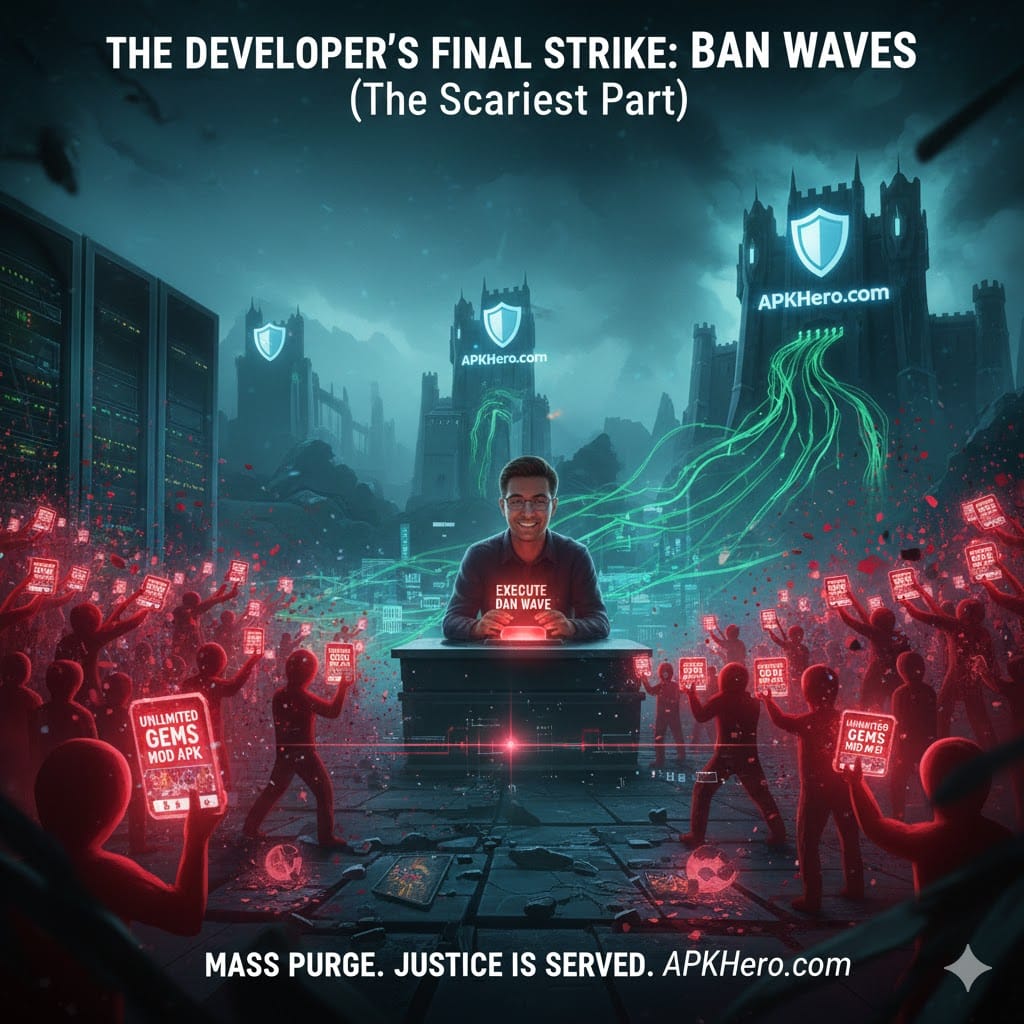
If an anti-cheat system detects you, why don’t you get banned immediately? Because immediate bans are the cheater’s best friend.
The Hacker’s Strategy
If a hacker gets banned immediately, they know exactly which piece of code in their Mod APK got caught. They can then go back, adjust the code, and test a new version right away. It helps them perfect their cheating tool quickly.
The Developer’s Strategy (The Wave)
Developers are smarter. They use Ban Waves.
- Detection & Logging: When the anti-cheat system flags a cheat (e.g., Mod APK Version 3.1), it doesn’t ban the account. It just secretly logs every single user running that exact version.
- Lulling into False Security: The cheaters keep playing for weeks or months, spending money, investing time, and assuming their mod is “undetectable.” They even advertise it as working!
- The Purge: When the developer has collected a massive list—maybe thousands or tens of thousands of users—they launch a Ban Wave.
The result is a digital apocalypse. Thousands of cheating accounts are banned simultaneously, permanently. The hackers, who thought their tool was safe, suddenly have zero feedback on what got caught, only that the tool failed. This strategy wastes the hacker’s time and maximizes the pain (and loss of paid cosmetics/progress) for the cheaters. It’s a beautifully cruel strategic move.
VI. Conclusion
As Rob, an expert in strategy games, I can confidently tell you that the old days of simple console cheat codes are over.
Modern games are now protected by layers of server validation, code camouflage, and AI behavioral analysis that make using a Mod APK an incredibly high-risk, low-reward gamble. You aren’t just downloading a shortcut; you are walking into an anti-cheat fortress where the punishment is swift, often delayed, and always final.
Remember: APKHero.com is here to give you the expert advice you need to game smart and stay safe. Don’t risk your digital kingdom—or your bank account—for a cheap, temporary thrill. Play legitimate, and let the developers keep the servers clean for us honest gamers.
Stay safe, and happy (and legitimate) gaming!
